
In the rush to own a home or start a commercial project in Ghana, many developers and individuals overlook one of the most critical legal requirements: the building permit. A common question asked is, “Can I start building while my permit is still processing?” or “What actually happens if I build without one?” This article breaks down the legalities, the risks, and the proper procedure for building in Ghana.
The Legal Requirement: Local Governance Act
Under the Local Governance Act, 2016 (Act 936) and the Land Use and Spatial Planning Act, 2016 (Act 925), it is mandatory to obtain a building permit from the District, Municipal, or Metropolitan Assembly (the “Assembly”) before commencing any physical development. This applies to new buildings, major renovations, and even the placement of temporary structures like containers or kiosks.
Can You Build Without a Permit?
The short answer is no. Building without a permit is a violation of the law. The permit ensures that your building is structurally sound, safe for habitation, and compliant with the zoning regulations of the area. For instance, it prevents you from building a factory in a strictly residential zone or constructing a house on a waterway, which could lead to flooding for the entire community.
The Risks of Building Without a Permit
If you choose to bypass the legal process, you face several severe consequences:
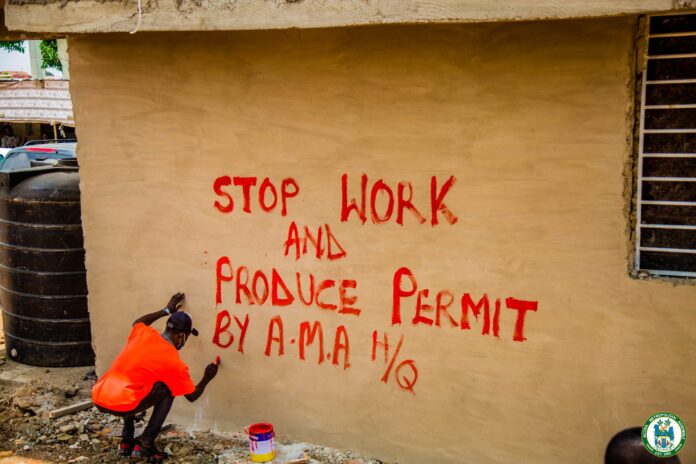
- “Stop Work” Orders: Assembly task forces regularly patrol development sites. If found without a permit, they will mark your building with “Stop Work, Produce Permit” and may seize your tools or construction materials.
- Heavy Fines: You will be required to pay a penalty, which is often 50% to 100% higher than the original cost of the permit.
- Demolition: In extreme cases—especially if the building is on a waterway, a road reservation, or is structurally unsafe—the Assembly has the power to demolish the structure at your expense.
- Difficulty with Utilities: Utility providers like ECG and GWCL require proof of a building permit before providing permanent connections.
Frequently Asked Questions (FAQ)
Q: How long does it take to get a permit in 2026?
A: Most Assemblies aim to issue permits within 30 to 90 days, provided all documents are in order. Some now offer expedited services for an extra fee.
Q: Can I build a fence wall without a permit?
A: Yes, you still need a permit for a fence wall, as it is considered a physical development that must align with the neighborhood’s spatial planning.
The Correct Procedure Checklist
- Land Documentation: Ensure you have a valid land title or registered indenture.
- Architectural Drawings: Have your plans drawn by a certified professional (Architect and Structural Engineer).
- Submission: Submit 4-6 copies of your plans to the Physical Planning Department of your local Assembly.
- Inspection: The Assembly will inspect the site to ensure it matches the submitted plans and zoning.
- Approval: Wait for the Statutory Planning Committee to grant the permit before starting work.
Case Study: The Cost of Demolition
In 2023, a developer in Weija built a three-story apartment block without a permit. The building was constructed on a buffer zone near the dam. Despite several “Stop Work” warnings, the developer finished the project. In 2024, the Municipal Assembly demolished the entire structure. The developer lost over GHS 1.5 million and was still billed GHS 50,000 for the cost of the demolition equipment used by the Assembly.
Conclusion
While the permit process can sometimes feel slow, it is a necessary safeguard for your investment. Building without a permit puts your capital and your safety at risk. Always ensure you have the “Permit Granted” sign before the first block is laid to ensure a peaceful and legal construction journey in Ghana.